


“Because in the end, you won’t remember the time you spent working in the office or mowing your lawn. Climb that goddamn mountain.”
I've done my fair share of travel and I continue to love exploring new places. Travel is a great way to learn about new cultures, language and see parts of nature that you may not be aware of. Recently, there’s been a lot of news about travelers disrespecting people, traditions and nature. I thought I’d share some of my tips for traveling with a more environmentally and socially conscious mindset. After all, we share one Earth and we share the same DNA.
Learn the Local Language
English is a commonly spoken language throughout the world, but it is not the official language everywhere. It’s important to know this. Countries and cultures have thrived without the need to speak English for years. For many of us, it may be shocking to visit places where English is not the primary language, but this is how the world works. It’s important the we put in the effort to learn a few phrases in the local language of the country you are visiting from. Trust me, it goes along way.
Of course, it’s not always easy to learn a new language, but even trying as best as you can will go a long way with the locals. The importance of “Please” and “Thank Yous” will net you a lot of points with the locals. Remember that you are a visitor.
If you are going to be refusing disposables, it’s nice to be able to respond back with a “No, thank you!” or “I have a bag” in the local language. My husband and I go to Istanbul often because his family lives there so I have learned to say “Çantam var!” which means “I have a bag!” in Turkish and I immediately put in on the counter to make sure there’s no confusion.
Get to Know the Local Customs

Turkish Coffee: sit, sip, chat, repeat.
Tradition and customs are important to me. I grew up in the Philippines and we have plenty of traditions that a typical American may not know. We always bless our elders which means taking their hand and placing it on our foreheads. We always provide “baon” which is leftovers for guests to take home. Side note: Filipinos (like most cultures show love through food) so a Filipino party will always have excess food. So in this case, having your own containers for leftovers will actually be so normal that there won’t be a second or strange look your way.
For my my husband’s culture, coffee is always taken sitting down. Turkish or Armenian coffee is a slow, sit, sip, chat kind of coffee. There’s no way around it. So it’s nice to be able to take some time out of the day to connect with others over coffee. Knowing, if you go to a cafe or visit someone’s home, that the coffee ritual is devoid of single-use cups or sugar packets can reduce the stress of needing to ask for it to-stay.
It’s important to recognize how cultures do things as it can dictate how you interact with people and situations. Of course, sometimes, you may not know what is happening so the best way is to observe, follow other’s lead and ask. Locals will always be happy to explain and show you what is going on.
Eat Local
Travel can be difficult and I know the feeling of homesickness and the feeling of resorting to familiar and friendly food to get comfortable. A few years ago, my husband and I were in China for 10 days. It was our first time and of course, a few days into it and many traditional Chinese meals later, I longed for a simple salad from a fast food chain. We did not end up going, but we did end up at a restaurant that made simpler fare without a lot of sauces.
Eating local has it’s advantages. Aside from getting to know the local produce, you end up supporting small businesses which keeps money local, you reduce the footprint of food and you tend to go to places that are maybe off the beaten path and perhaps more traditional with food preparation (and in many cases, more delicious).
If you are unsure what a dish is, ask! It never hurts to want to know what’s in something. In some cases, you may have to just accept what is offered to you as most of the time they are gesture of appreciation for your presence.
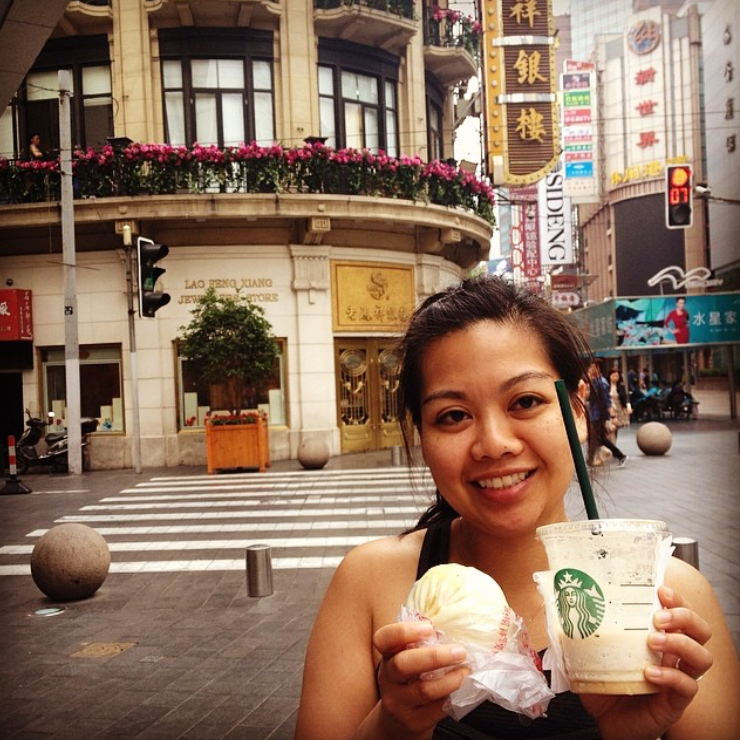
China in 2014 eating dumplings and having Starbucks in the morning. I’ve learned better habits since then.
I’m a big fan of pastries and chocolate so I’ll be the first to check out small vendors that sell local pastries. I also like to browse the grocery aisles for items I would never find at home as food souvenirs. Most of the time this has ended up being a local, favorite candy or chocolate in plastic but they’ve never gone to waste. I would bring a pack to work and for home to be enjoyed for a few days.
I will also be the first to admit that at one point, seeing and drinking Starbucks was a comfort for me, but I’ve learned to live without when traveling to other parts of the world.


Respect the Currency Difference
I’ll be the first to admit that part of the reason we travel to certain areas is because our currency goes a lot farther. Geoarbitrage is a real, a genuine concept and it’s one that we can take advantage of, but it should also be one that we respect. Going to a country where the standard of living is comparable but at significantly lower cost can make you feel like a queen. Let’s not be greedy about getting discounts or haggling. Many people in many parts of the world do not make $1 a dollar a day. This is reality so when we haggle to get something discounted (even though it’s already so low where we come from and even though haggling is customary), it demeans people and their livelihood. Unless people are downright trying to rip you off, be conscious about how you spend your money.
Many years ago, I went to Africa on one of my first ever solo trip to attend a friend’s wedding in Zambia. We visited a local market and I ended up buying a few things (before I learned that I really didn’t need souvenirs). I haggled because it was the thing to do, even though I was bad at it. Coming back to our hotel and calculating how much I spent, I didn’t feel the joy of buying something on sale, I felt bad for how much I devalued people’s work and items.
In the same vein, when we are in the Philippines, I am always conscious of how much farther our dollar goes. I also see myself in the people selling things on the street and getting cents for things they’ve worked so hard for. It gets disheartening. While we can’t save everyone with money, the least we can do is be respectful of how people are making a living and put cost and value in mind.
Take Photos, Leave Only Footprints and Spread Positivity of the Visited Places
Travel is temporary. It is unfair for us to visit a place, trash it for the few days we are there and leave it behind. A conscious traveler will be mindful of how he/she interacts with the place, what they leave behind and what they bring with them. As a visitor, we now represent a portion of the country or place we’ve visited and we also represent the country where we came from. It’s important we share mutual respect. We need to be aware of how we speak about the place, it’s people, culture, food, traditions, etc. There is no one way to live life and the differences that we all experience and share is what makes this world amazing and unique.
“would
you still want to travel to
that
country
if
you could not take a camera with you.”
I’ve been pondering this question since I’ve seen it. In the age of Instagram, #yolo, #fomo, how can we truly appreciate where we are if there’s no proof we were there.
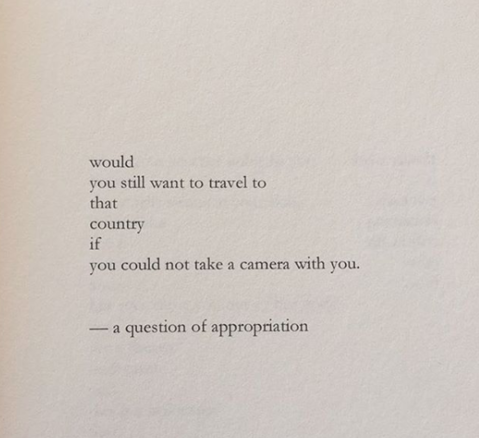
would you still want to travel to that country if you could not take a camera with you
― Nayyirah Waheed
Have you traveled lately? How have you made your travels more environmentally or socially conscious?


I was in love with New York. I do not mean ‘love’ in any colloquial way, I mean that I was in love with the city, the way you love the first person who ever touches you and never love anyone quite that way again.
I fell in love with New York City at the age of 21. My roommate and I attended a New Year's party at Webster Hall and we had one of those random, New York nights weaving in and out of different crowds and neighborhoods. It was an unusually warm New Year so New York in the early morning felt special. As a girl growing up in New Jersey, New York was a 40 minute train ride away. At 22, I interned at the Met Life building on top of Grand Central commuting by bus. Each time the bus curves towards and away from the New York City skyline, I also smile. Post college, I accepted a job in New Jersey and would take a day or two to explore the city every few months. I eventually ended up working in New York City, but the grind of the daily commute, the constant push of tourists when all you wanted to do was get to your office got to me and I fell out of love with New York. I admired New York from afar, enjoying the skyline and the quietness that came with it. Add another year or two and I'm now back into falling in love with New York, but now with new eyes. What follows are tips on how to enjoy New York city without generating too much waste. I call this being a conscious traveler. My ask is to fall in love with New York, but don't leave it broken-hearted with waste and trash.